Since my unsuccessful run for Congress, the number one question I’ve gotten is: what will you do next? Well, after not sending any updates to you all in about three months, I figured it’s high time to answer that.
On June 2, I was of course disappointed by the results, but I don’t regret running. I am incredibly proud of the campaign we ran and especially of the people who volunteered and worked on the campaign. Most of the people who showed up to our canvasses, town halls, and rallies were completely new to politics. We mobilized a whole new electorate in San Francisco, and together, we created an incredibly impressive voter contact program. Part of that was the hard work everyone put in, but a lot of it was the culture of that team. This was honestly the best group of people I’ve ever worked with.
Throughout the campaign, I said constantly that it wouldn’t be enough to just elect me to Congress. If we want to pass Medicare-for-all, tax the rich, end corruption in our politics, and wrench control of our government away from the corporations and back into the hands of people, it will take a movement of elected officials working together on the inside, backed by a movement of people supporting them on the outside. That kind of inside-outside organizing has been at the center of every big moment of change in our history, from the New Deal to the civil rights movement.
That’s why, at our biggest rally of the campaign, we didn’t just promote our own race. We brought Darializa Avila Chevalier, Melat Kiros, and Angela Gonzales-Torres out here to show the strength of this movement and support their campaigns too:
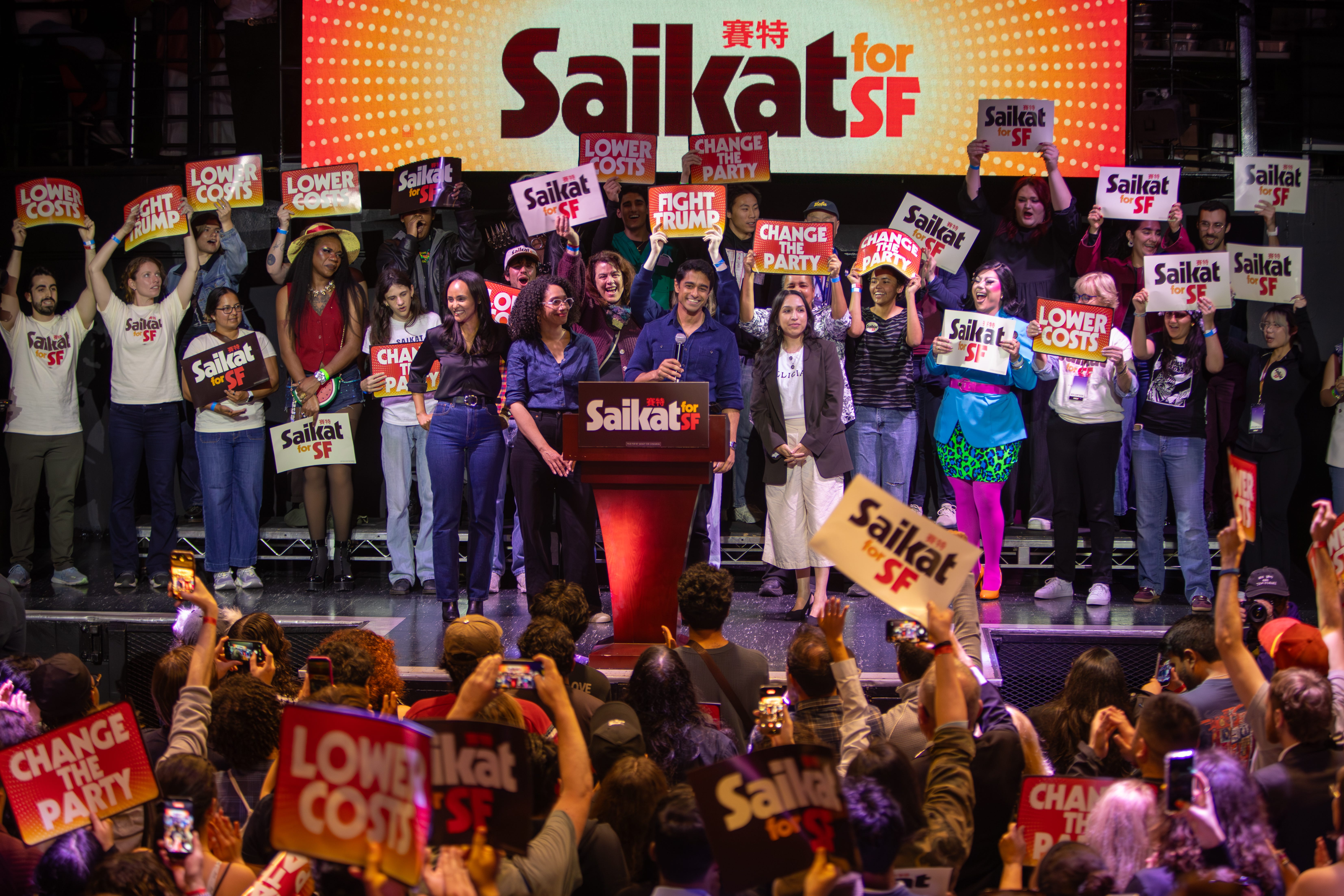
So even though I won’t be part of that movement on the inside, I can still be part of it on the outside. Here’s what that’s looked like so far.
SF Solidarity PAC
On June 3, the day after the primary, we got to work helping progressives get elected across the country. We started SF Solidarity PAC to point our people-powered voter contact machine at other races.
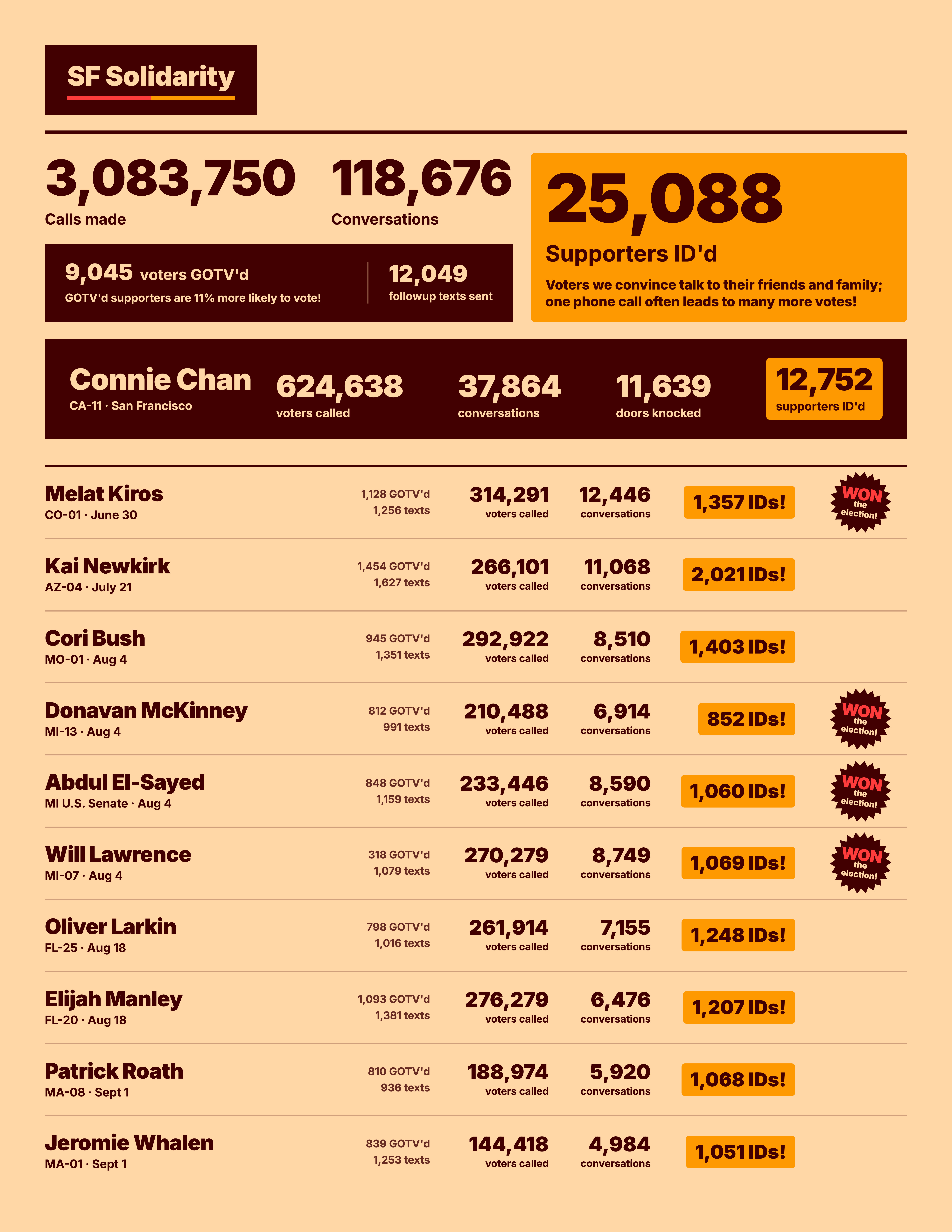
Here in San Francisco, we’ve been knocking doors and making calls for Connie Chan. I ran against Connie in the primary and we have our disagreements, but it was clear to me that in Congress she’ll work with other progressives on the issues I care most about. She takes no corporate money and has been an active fighter against corporate influence in San Francisco. She supports wealth taxes on the ultra-rich. And I’m glad to see she’s come out for an arms embargo on Israel to stop U.S. support of the genocide in Gaza. All told, so far we’ve talked to nearly 40,000 San Franciscans after making about 650,000 phone calls and knocking on about 12,000 doors for her, and we’re continuing to do that work through November.
Beyond San Francisco, we’ve been phonebanking for races across the country — sometimes winning, sometimes losing, but doing everything we can. We just wrapped up the last primary of the cycle in Massachusetts, and here’s the final results of what we were able to accomplish:
I ran this cycle because I felt we had a huge opportunity to elect a new group of progressives. The moment today reminds me of 2018. Back then, people were furious at the Democratic Party for losing to Trump and were looking for new leaders with a different vision. That moment of change is what allowed us to elect The Squad and push big new ideas like the Green New Deal, which ended up shaping a lot of the Democratic agenda under Biden.
But the appetite for change today dwarfs anything I’ve ever seen, and I thought we had a shot at electing a much larger class of fighters willing to work together for a country that works for everyone, not just the wealthy few. That instinct has largely proven right. In 2018 we elected four amazing progressive leaders; this cycle, we’re already well past that. To everyone who worked and volunteered to help get these leaders elected: THANK YOU. You’ve already made a huge difference, and I believe 2026 is going to be remembered as the beginning of huge change in this country.
A new democratic club in San Francisco
In July, we held a thank-you party for our volunteers and announced a new democratic club in San Francisco. About 200 people showed up.
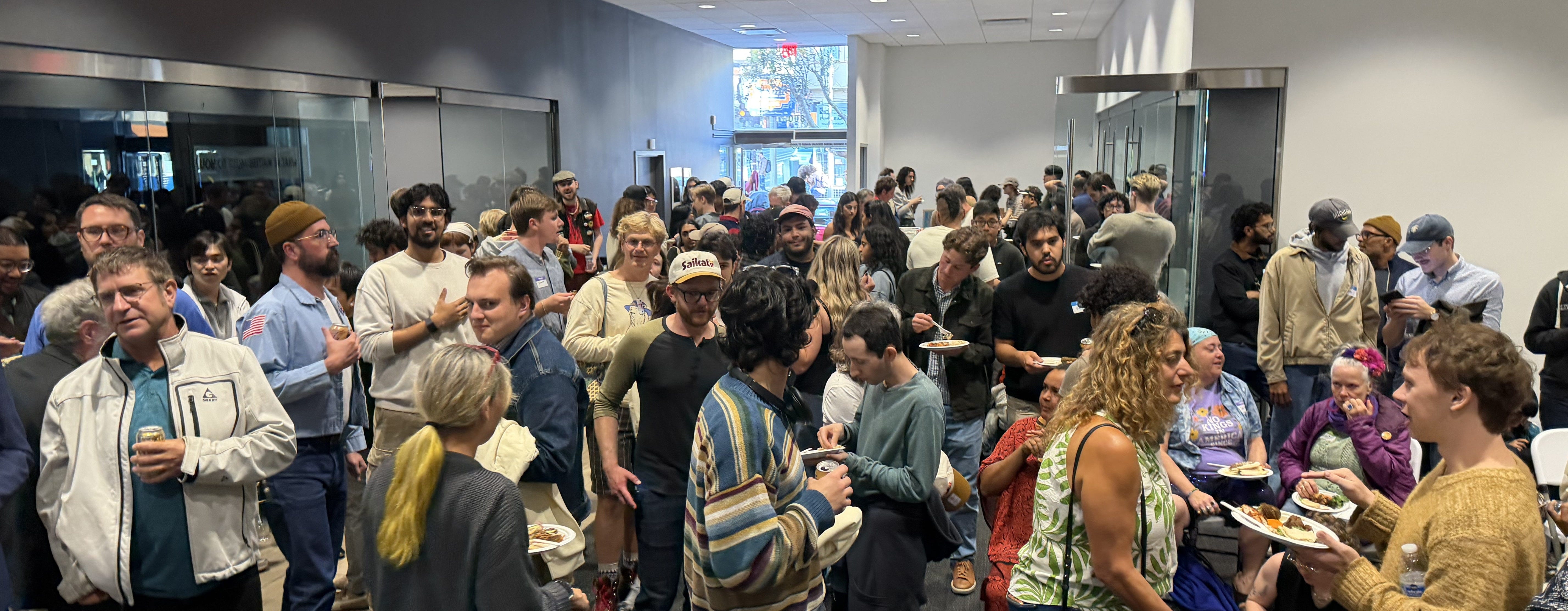
Democratic clubs in San Francisco have real power in shaping the party here. Most clubs in the city are organized around identity or neighborhood (nothing wrong with that, of course!), but we felt the city needed one organized around actual policy. And if the volunteers and staff from our campaign mostly joined, we'd have one of the largest and most powerful clubs in the city.
The club is still new. We’ve just elected officers and are meeting now to hammer out the basics: bylaws, values, and endorsements for this cycle. If you live in the Bay Area and want to be part of it, join our Discord server here:
Why I’m going back to policy, and the 2028 moment
Looking ahead, I believe the opportunity is huge. A new class of progressive, anti-establishment fighters is headed to Congress, and the truly exciting part — having talked to many of them — is that they want to actually do work together, not just be individual congresspeople. I’m feeling plenty of FOMO not being in there organizing with them, but I plan to support them from the outside and help them lead the fights.
At the same time, the Democratic presidential primary is going to kick off right after November, and it’s going to be a fight over ideas and vision unlike any we’ve seen. After 2016, a lot of Democrats treated Trump as an aberration and assumed there was a “normal” we could go back to. That was much of the case for Joe Biden — the safe, back-to-normal candidate. But Trump winning a second time, and then dismantling so much of our federal government, norms, and institutions, has shown people there is no normal anymore. We have to build something new.
Presidential primaries are the moment when the entire direction of the party can change. That was the whole strategy behind the Green New Deal in 2019. We never intended to “pass” it. The Green New Deal was a resolution outlining how to build a clean economy that would create millions of high-wage jobs. The goal was to force everyone running for president in 2020 to respond with their own ambitious plans and to mainstream ideas like industrial policy. And because of how primaries work, that’s exactly what happened. Every candidate needed to distinguish themselves and push new ideas, and even Joe Biden responded with Build Back Better — a moderate plan that was still bigger than anything a Democratic president had proposed before.
So in 2028, at a moment when everyone is demanding a new vision, the opportunity to pitch big, bold ideas is enormous. That’s why I’m going to focus the bulk of my time on policy and vision at New Consensus.
New Consensus
New Consensus is a think tank I co-founded in 2017. At the time, I was working to recruit candidates to run as Justice Democrats on an agenda that combined the Bernie 2016 platform with a vision for economic development and growth. When we looked around DC for think tanks working on the ideas we were pushing — industrial policy, using the state to build the economy we need — there weren’t any. So we started one.
At New Consensus, we believe there’s a tried-and-true playbook for getting economies unstuck and creating shared prosperity. We last used it in the New Deal and the World War II mobilization to build our industrial economy. And around the world, pretty much every modern developed nation today, from Asia to Europe, has used it as well. And right now, we have an incredible opportunity to put that playbook to work by tackling the massive challenges of today like climate change and AI.
A lot of the early development of the Green New Deal came out of New Consensus, and we’ve been working on a number of projects since, which I’ll cover in future posts. The biggest is the Mission for America — a comprehensive, detailed plan for how exactly we mobilize our economy to build clean alternatives in every sector and create the industries of the future where, frankly, China is kicking our ass.
We also have a wealth tax plan, a CrashLab, which monitors how close our economy is to a crash, and we’re working on plans for healthcare, what to do if the AI bubble pops, and a Project 2029 outlining what a Democratic president with a Democratic Congress could do — even without getting rid of the filibuster.
I got into politics because I believe our economy is really stuck, and we need to fundamentally change our politics to change our economy. I’ve always approached this work policy-first. So it’s very exciting to me to be able to go back to dedicating most of my time to the policy. Of course, I’m going to also continue doing everything I can to make sure that policy actually goes somewhere. That means engaging with members of Congress – especially the new group of progressives who are going to be willing to take risks – and continuing to spread these ideas in the media and social media.
So, to that end, I’m going to use this Substack to talk about that work. But I’d also love to hear from you all about what you’d like to read about. So comment on this post (or reply to this email) to let me know if there’s anything you’d like for me to cover.
Thanks for sticking with me. More soon.