
Democrats are likely to win big on Tuesday, but the more important question is which Democratic Party wins. Here are the races that will decide whether the party heading into not just the next Congress, but 2028, is one that tweaks the status quo or one that takes on corporate and billionaire power and is willing to make transformational change to our economic system.
The races around the country that are getting the most attention – and rightfully so – are the ones that will determine who controls the next Congress and how badly the Republican coalition has been fractured. But it’s become pretty clear that Democrats are very likely to win a healthy majority in the House and might even win a majority in the Senate – something that was unthinkable a year ago. So I wanted to talk about something different in this post. I wanted to talk about the races that will determine what kind of Democratic Party will be taking power next Congress, how that will shape the kind of Democratic Party that may be in charge two years from now, and why that is so important.
The Republicans are in ruins right now because they are being led by a historically unpopular buffoon who decided to put America into another endless war, jack up the price on everything, and take part in corruption at a level we’ve never seen. Because of that, Democrats have a chance to win a landslide election at a scale we haven’t seen since after Watergate. But Democrats shouldn’t assume a big win in November is the same as people loving Democrats. In fact, right now, Democrats are only slightly more popular than Trump:
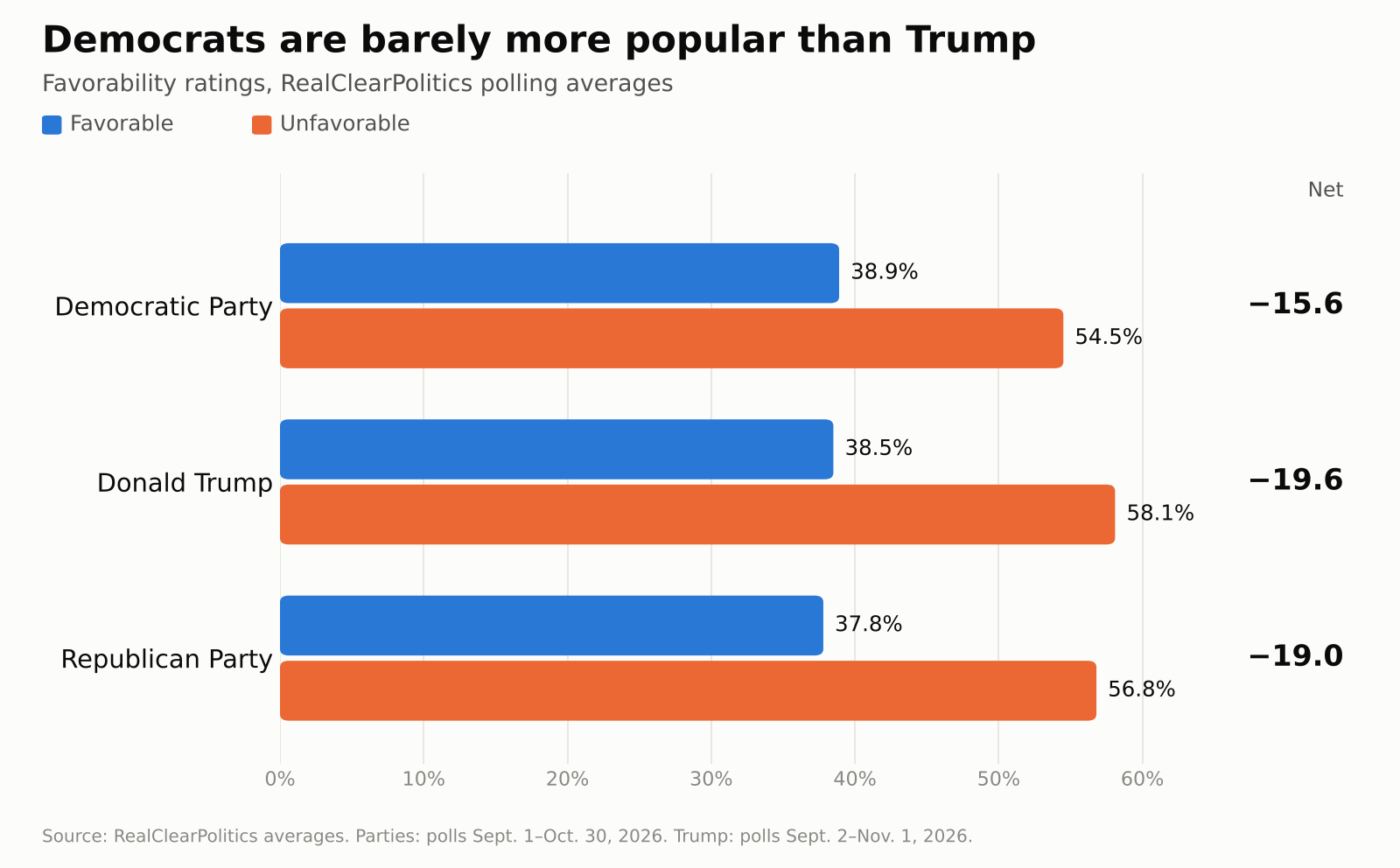
People are going to vote for Democrats because they’re the other option. But, importantly, what Democrats do next year and in 2028 WILL give Democrats a chance to rebuild their trust with the American people, and right now there are two very different views on where the Democratic Party should go.
One wing of the Democratic Party is starting to realize that it won’t be enough to say we go back to a pre-Trump status quo. So they have started using some of the correct rhetoric, such as espousing universal healthcare or saying inequality is too high or calling for regulations on AI or saying that what Israel is doing in Gaza is wrong. But they are also unwilling to directly challenge corporate power, billionaire power, or the power of our military-industrial complex because they are afraid that doing so will mean the wealthiest donors will flee the Democratic Party (even though they mostly already give to Republicans anyway). They are afraid to invest in our economy at the scale we need to really turn it around and create a country that can build and produce again. In short, they are afraid to fundamentally change a system that has been broken.
The problem is that actually creating universal healthcare, or effective AI regulation, or tackling inequality, or breaking our war-driven foreign policy, or building an America that can build at speed and scale will not be possible unless we break the stranglehold corporations and billionaires have on our government and politics. It will not be possible if the only policy solutions out there are about tweaking a regulation here or there rather than making investments at a scale we haven’t seen since the New Deal and World War II mobilization. This wing of the party is led by people like Hakeem Jeffries, Chuck Schumer, and Gavin Newsom.
I’m afraid that if this ends up being the dominant force in the Democratic Party, we will end up with Democrats gaining power in this election and in 2028 by saying the right things on the campaign trail, but then failing to deliver on those promises once in power. And if that happens, the backlash from voters will end up electing someone even worse than Trump in 2028 or 2032.
Then there is another wing of the Democratic Party that believes the fight is not left vs. right, but top vs. bottom. This is the Democratic Party that traces its roots to the New Deal and the Great Society. This wing is defined by candidates who are taking no corporate money, who are often going up against AIPAC, and who are willing to call out BS in our own party’s leadership. They understand our country needs transformational change, not just a few policy tweaks. They are the fighters who realize we can’t fight fascism while taking orders from the same oligarchs who are funding it.
A lot of the fight over these two visions of the Democratic Party played out in the primaries earlier this year. But there are still plenty of races in November that will determine where we are headed and give us a clue as to which Democratic Party emerges as the dominant force over the next six years.
Notice that I said six years there, not two. That’s because the larger effect of this midterm election is going to be determining how the 2028 Democratic presidential primaries go and then, if a Democrat wins and has a majority in the House and Senate, how the Democrats will govern with that power. Even if progressives across the country win their elections but aren’t a majority of the Democratic caucus in the next Congress, they will have a megaphone and outsized influence as an ascendant force inside the party.
In 2018, when I was working with AOC and helped elect the Squad to Congress, we were in a similar spot. The entire media ecosystem wanted to cover what they’d do, and we capitalized on it to push ideas. During her first week of freshman orientation, AOC joined the Sunrise Movement for a sit-in in Nancy Pelosi’s office, and the press, which loves conflict, ate it up. But critically, AOC used the sit-in not just to criticize Pelosi, but to push something new: the Green New Deal. We then launched the full Green New Deal right as the 2020 Democratic presidential primaries were starting, with the explicit goal of pushing Democratic presidential candidates to adopt ideas like industrial policy and set real goals for building a clean economy by investing at a scale not seen since World War II. The result was that everyone running for president responded with their own ambitious plans to tackle climate change – and importantly, their plans were not just some regulatory reforms, but actual plans for investing in and building the alternatives to our current dirty, expensive energy system. Even Joe Biden responded with Build Back Better, which eventually became, in pared-down form, the Inflation Reduction Act and passed. It wasn’t everything we wanted, but it was the largest investment in tackling climate change in history and the biggest investment in union jobs since the New Deal.
The moment we are in now completely dwarfs what we had in 2018. The Squad was four people – the new progressives entering Congress next year will number way more than that. In 2020, there was still an appetite in the Democratic Party for going back to the halcyon days of Obama. Today, nobody running for president will be able to pitch a return to a pre-Trump status quo. Everyone running for president in 2028 will have to pitch new ideas and a real vision, and this is exactly where the new bloc of progressives getting elected will have outsized influence. And of course, the policies these progressives are running on are popular – not just in the Democratic Party but in the country at large. Ideas like Medicare for All, taxing billionaires, reducing funding for endless wars, and ending our funding of Israel’s genocide all have majority support in recent polling, and some have supermajority support. The question now is simply: will we have leaders in DC with the guts to push the will of the American people in the halls of power? That’s what is really at stake tomorrow, and these are the races that will shape it.
The Senate Races
Not every race I’m paying attention to is under the radar. Most of the Senate races are definitely getting the attention they deserve because they’ll determine if Democrats retake the Senate.
Minnesota - Peggy Flanagan
Michigan and Minnesota are both open seats that are must-holds for Democrats to regain control, and in both, we have unapologetic progressives likely to win. Peggy Flanagan is the Bernie-backed progressive who crushed her corporate-backed opponent in the primary by about twenty points. If elected, she’d be the first Native American woman to ever serve in the Senate.
Michigan - Abdul El-Sayed
Michigan is arguably a more consequential seat for a progressive to win. Any Democrat running for president needs to win Michigan. Obama won it twice, Trump flipped it in 2016, Biden won it back in 2020, and Trump took it again in 2024. More than any other state, Michigan represents the rise and fall of American industry. A politics of rebuilding Michigan is a politics of rebuilding the country.
The race in Michigan has also put every argument against progressives to the test. Abdul El-Sayed hasn’t backed away from his progressive agenda since winning the primary. His main message is still “money out of politics, money in your pocket, and Medicare for All.” Republicans, meanwhile, are running on straight-up bigotry: their main line of attack is that he’s Muslim and therefore dangerous. They’ve spent about $70 million on ads against him.
That’s why, if Abdul wins, he’ll become one of the most powerful voices in Congress. He’ll show that a politics of hatred, no matter how well funded, can’t beat a bold candidate who doesn’t back down. He’ll become a de facto national leader of the progressive movement, and his campaign will be the blueprint for the 2028 Democratic presidential primary.
Florida - Angie Nixon
The harder races on Tuesday will be Florida and Nebraska. In Florida, Angie Nixon is a democratic socialist who beat Alex Vindman in the primary despite being outraised about 16-to-1. She hasn’t backed away from who she is or what she stands for, and unlike Michigan, Florida is no longer a purple state. It has become reliably Republican. A democratic socialist becoming the first Democrat to win a Senate race in Florida since 2012 would shatter conventional wisdom about electability in red and purple states, and her campaign would become a blueprint for populists running in red states across the country. Polls have Moody ahead, but early-vote data shows a surge for Democrats, so Nixon still has a real chance.
Nebraska - Dan Osborn
Nebraska is even redder than Florida, and Dan Osborn, a union leader and mechanic, is running there as an independent against billionaire Pete Ricketts. Two years ago, he came within about seven points of winning, running well ahead of Kamala Harris in Nebraska. This year, the polling averages have him down but close. If Osborn wins, it will show that a working-class populist campaign can win even in states Democrats gave up on long ago.
The House Races
CA-07 - Mai Vang
In California, we have a jungle primary system where the top two in the primary, regardless of party, make it to the general. As a result, we still have a number of Dem-on-Dem races in our general election tomorrow where the winner will determine what kind of Democrat takes the seat.
In CA-07, Mai Vang is going against 82-year-old incumbent Doris Matsui. Matsui takes AIPAC money and is heavily funded by corporate PACs. Mai Vang, on the other hand, is not just a progressive on the issues - she’s been clear that she won’t support Hakeem Jeffries for Speaker of the House, so she’s willing to take real risks to change things. And we need more people like Mai in Congress so we CAN change Democratic Party leadership – it’s something even Democrats in Florida want to see! Vang is up in the latest polls, but just barely.
CA-34 - Angela Gonzales-Torres
Gonzales-Torres is challenging Jimmy Gomez. On the surface, Gomez doesn’t seem like the worst incumbent. He’s a member of the Congressional Progressive Caucus and supports Medicare for all, which has meant no sitting progressive in Congress has come in to support Angela (other than Ro Khanna, who actually has some courage when it comes to challenging his own party). But in reality, Gomez is a textbook case of a progressive who says the right things and votes the wrong way.
Gomez has taken millions from AIPAC. He is, in fact, one of the top 10 Democratic AIPAC recipients. He also voted to deregulate the crypto industry by voting for the GENIUS and CLARITY Acts – votes that he’s been handsomely rewarded for with crypto money backing his campaign. And worst of all, he’s been credibly accused by a former staffer of sexual assault. It’s well known on Capitol Hill that Gomez and Swalwell, who recently had to resign because of his own sexual assault claims, were close drinking buddies who partied together. Los Angeles deserves better than representatives who say the right things on Medicare for All while actually doing the bidding of AIPAC and the crypto lobby.
CA-11 - Connie Chan
Connie Chan is running against Scott Wiener in CA-11 – Nancy Pelosi’s old seat based in San Francisco. This is home for me and I ran a primary against both Connie and Scott. So suffice it to say – I have my disagreements with both of them. However, most of my disagreements with Connie are on local issues like transit or housing that Congress has little to do with other than funding both (which she heavily supports).
In Congress, the big fights are 1) taxing the wealth of the billionaires, 2) taking on our military-industrial complex and our funding of endless wars and genocides, 3) doing real regulation of the AI industry, not weak bills, and 4) removing corporate money from our politics. In those fights, Connie is on the right side, and Scott simply isn’t. Connie supports a wealth tax on billionaires and supports California’s billionaire wealth tax – Prop 40 – while Scott doesn’t. Connie supports a full arms embargo on Israel to stop the genocide there, while Scott doesn’t. Connie is willing to call for a data center moratorium until we get real regulations – something even tech billionaire Chris Larsen now backs – while Scott doesn’t. And Connie takes no corporate money and never has, while Scott is one of the most heavily corporate-backed candidates in California.

Scott Wiener likes to talk about how he led on AI regulation, but if you look at the law he actually passed, it has been watered down to the point of meaninglessness. Reportedly, he met with industry lobbyists before passing it and his explanation was that he had to make tradeoffs to pass the bill. But the tradeoffs he made – like reducing fines on AI companies to only $1 million per violation, or reducing whistleblower protections – sound a lot more like industry giveaways than good-faith tradeoffs on the question of safety vs. innovation. And as an example of just how ineffective the law is – it wouldn’t have even covered the Hugging Face hacking attack from earlier this year.
In Congress, I worry Scott will be seen as a progressive from San Francisco and use that position to provide cover for the corporate wing of the Democratic Party.
CA-14 - Aisha Wahab
Aisha Wahab is already in Congress. In August, she won the special election to finish Eric Swalwell’s term after he resigned amid sexual assault allegations, and she became the first Afghan American ever elected to Congress. On Tuesday she has to win the seat again, for a full term, against the same opponent.
That opponent is Melissa Hernandez, a moderate who serves as BART board president and was previously mayor of Dublin. She’s backed by police unions, and AIPAC has gone all in for her. AIPAC’s super PAC, the United Democracy Project, spent close to $2.5 million attacking Wahab, and Bold America, a group funded by UDP, added roughly another $1.8 million (JTA). By most estimates, the total is around $5 million. The ads mostly don’t mention Israel. They try to paint Wahab as soft on crime, because AIPAC knows that attacking her on Gaza wouldn’t work with Democratic voters.
The difference between the two candidates is clear. In a debate, Wahab was asked whether Israel’s war in Gaza is a genocide, and she said yes. Hernandez wouldn’t answer yes or no. Wahab is a daughter of Afghan refugees who is running on housing, healthcare, childcare and “No More Wars,” and she’s endorsed by labor unions, the California Democratic Party, and Our Revolution.
Wahab crushed Hernandez in the June special primary, 43% to 17%. Then the AIPAC money arrived, and the August runoff ended 53–47 (Danville San Ramon). That was a win, but a much closer one, with turnout of just 23%. Hernandez called the November rematch “game on.” Higher turnout on Tuesday should help Wahab, but this is the clearest test in the country of whether AIPAC can beat a progressive with enough money.
CA-04 - Eric Jones
Mike Thompson has represented much of the North Bay since 1999, nearly 28 years. He’s a perfectly pleasant, establishment Democrat, and that’s the problem. In this cycle alone, Thompson has taken $745,000 from 251 PACs, including PricewaterhouseCoopers, Constellation Brands, and insurance giants like AFLAC, Travelers, and Prudential. Asked about it, he said he’s “not embarrassed for taking those.” He’s also taken money from PG&E’s PAC, in a district that has been devastated by PG&E-caused wildfires.
Eric Jones takes no corporate PAC, lobbyist, or special-interest money. He’s running on a platform built for working people:
Medicare for All, with expanded coverage for dental, vision, hearing, and in-home care
Universal childcare
A $10,000 tax refund for working-class families, paid for by closing the corporate tax loopholes and offshore tax havens that people like Thompson’s donors use
Banning members of Congress from trading stocks
Term limits
Jones came in second in the June primary, behind Thompson and just ahead of the top Republican. It’s an uphill race, and to win he’ll have to bring in independents and even Republicans. He hasn’t strayed from his message in the general election, so if he manages to do that while keeping his populist messaging, it will show how populism can win across party lines in any district.
CA-22 – Randy Villegas
Unlike the other California races on this list, this one’s against a Republican. The Central Valley’s 22nd District is majority-Latino and working class, and Republican David Valadao has held it for years by convincing voters he’s a moderate. Then he voted for Trump’s One Big Beautiful Bill, including an estimated $911 billion in Medicaid cuts, in one of the districts that depends most on Medicaid in the country. Randy Villegas is a 31-year-old community college instructor and Visalia school board trustee who isn’t running as a Republican-lite Democrat. He’s for universal healthcare, opposes the wars in Iran and Gaza, opposes military aid to Israel, and has stood up against ICE sweeps in a district full of farmworker families. Republicans thought he’d be easy to beat: their super PAC boosted him in the primary. Now the race is a toss-up, and a Villegas win would bury the idea that progressives can’t win swing seats in the Central Valley.
MI-07 - Will Lawrence
Michigan’s 7th District, around Lansing, is one of the swingiest seats in the country, exactly the kind of place the consultant class says needs a cautious, centrist Democrat. Will Lawrence is proving them wrong. He won a competitive primary with Bernie Sanders’s backing, and since then he’s leaned harder into Medicare for All, not away from it. He’s also taken on the data center buildout that’s driving up utility bills and draining water across Michigan, an issue The New Republic has highlighted and one more Democrats should be running on. I’ve actually known Will for nearly a decade now. I first met him in 2018, during AOC’s sit-in in Nancy Pelosi’s office, when he was working for the Sunrise Movement. If he can beat Republican Tom Barrett, it will show that running on bold economic populism in a swing district is a winning strategy.
TN-09 – Justin Pearson
Justin Pearson first made national news in 2023, when Tennessee Republicans expelled him from the state legislature for protesting gun violence. Voters sent him right back. This year, Republicans came after him again. After the Supreme Court gutted the Voting Rights Act in Louisiana v. Callais, they held a special session to carve up Memphis. They turned a district Democrats had held for over 40 years into an L-shaped seat that stretches from wealthy suburbs through rural Tennessee and leans Republican by 9 points. Pearson ran anyway, won the primary, and now faces Trump-endorsed state Senator Brent Taylor. This is the hardest race on my list, and arguably the one that matters the most. If Pearson wins a seat drawn specifically to keep someone like him out of Congress, it will be one of the biggest statements of the night. And given Taylor’s recent scandal, Pearson really may do it.
I’m also excited about this race because of who Pearson is. I had the opportunity to hear him speak recently at an event, and he is a uniquely talented orator and politician. However this race turns out, I know this won’t be the last we’ve seen of Pearson.
Ballot Propositions
Some of the most direct fights over corporate and billionaire power on Tuesday aren’t between candidates at all.
California Prop 40
Prop 40 is a one-time 5% tax on the wealth of California’s billionaires, with 90% of the money going to Medi-Cal to backfill Trump’s healthcare cuts. It’s the clearest test in the country of whether Democrats will actually tax concentrated wealth or just talk about it, and it’s become a clear wedge between the two visions of the party I talked about at the top. The California Democratic Party and Ro Khanna have endorsed it. Gavin Newsom not only opposes it, he endorsed Prop 42, a measure bankrolled by Google co-founder Sergey Brin that would cancel Prop 40 and ban future wealth taxes. If you’re in California, vote Yes on 40 and No on 41 and 42. Voting yes on 40 alone isn’t enough. And if you aren’t fully convinced, read my longer post taking on all the arguments against Prop 40.
Washington I-645
Earlier this year, Washington finally passed a 9.9% tax on household income over $1 million, in a state with one of the most regressive tax systems in the country. Now a repeal initiative, I-645, would scrap it and ban any future state or local income tax. That would strip funding from K-12 schools to protect a tiny number of the state’s richest households. Governor Ferguson and organized labor are leading the No campaign. Like Prop 40, this is one of the clearest tests of whether we can take on the wealth of the richest in our country.
Montana I-194
This might be the most creative attack on corporate money in politics in a generation. Instead of waiting for the Supreme Court to overturn Citizens United, Montana’s I-194 goes after the powers states grant corporations in the first place. It would bar corporations doing business in Montana, along with dark-money groups, from spending in elections. It has support across the spectrum, from Jon Tester to former Republican Governor Marc Racicot. The Montana Chamber of Commerce sued to keep it off the ballot and lost. It will almost certainly end up in court if it passes, but a win in a state Trump carried would show that taking money out of politics isn’t a left-wing idea, but an American one. And if it holds up in court, this gives us a blueprint for getting rid of corporate money in politics once and for all, even without the Supreme Court.
There’s a lot to be worried about in the world today, but I’ve never felt as optimistic about the future as I do right now. Part of that is the incredible leaders already headed to Congress, and the ones who will, hopefully, join them tomorrow. But the bigger part is what I’m seeing among people. People are fed up with the status quo and demanding change at a level I’ve never seen in my lifetime. We’re at a moment where anything really is possible. The biggest ideas no longer seem radical; they seem like common sense. We have a real chance to fundamentally reshape this country so it works for everyone, and to break the stranglehold corporations and the ultra-rich have had on our politics for so long.
It won’t be easy, but it’s happening. So wherever you are, vote.
“Then there is another wing of the Democratic Party that believes the fight is not left v. right…but top vs. bottom. This is the Democratic Party that traces its roots to the New Deal and the Great Society…defined by candidates who are taking no corporate money, who are often going up against AIPAC, and who are willing to call out BS in our own party’s leadership. They understand our country needs tranformational change…”
Thoughtful analysis. I especially appreciate the distinction between reforming the existing system and pursuing genuine transformation. It raises an important question: How do we ensure that challenging concentrated power leads to lasting structural change, rather than simply replacing those who hold it?